In the last few weeks, a couple of friends have asked me about making their first quilt. Is it complicated? Is it going to be too advanced for their sewing? And how long will it take?
They don't tend to believe me when I tell them that a quilt is only as hard as you make it. Most people think of a quilt as lots of little squares sewn together and yes, that kind of quilt can take a while. But a quilt top can really be quite simple and still be very effective.
This is a quilt I made from a single piece of flannel with appliqued flowers and birds. Didn't take too long to make, although (as with most quilts) the most time consuming part was the cutting out.
The principles of this 'quilt in an hour' can be applied to any fabric, and you can make a quilt with just single pieces of fabric for the front and the back. For these, more elaborate quilting can really make the quilt something impressive - but elaborate quilting is beyond me!
I recently saw a quilt that was simply a plain white piece of fabric and a contrasting backing. What made it special was that the quilter had used a huge variety of stitches and threads to quilt an elaborate bird on the fabric, and thus turn a plain piece of cloth into an amazing quilt.
A quilt is really just a sandwich of layers: top, wadding, and backing. It doesn't have to be squares, and it doesn't have to take months. A few examples:
This is the quilt I made last week. I started on Monday night, and finished it on Wednesday. The actual quilt top construction took a few hours; the rest was the binding. It was made with fabric from Africa, bought and given to me by my mother-in-law, and the quilt was a gift for her.
To make it, I simply cut strips of the dark blue fabric and strips of the same width from the unbleached cotton. I varied the width of the strips so they ranged from about 4-10 inches. Then, I joined them together at an angle, again varying the length of the blue pieces. I wanted to bring out the green in the blue pattern, so I appliqued the green rectangles over top of the strips once they'd been sewn together. It was backed with another yellow fabric she'd given me, and I used the green for the binding. Simple simple, but it looks smart!
Try buying 20cm strips of 6-8 different, complementary fabrics and sewing them together for a super easy baby quilt - have a look at this blog for inspiration! Make your quilting as simple or as complicated as you can handle, finish off the edges, and you're done. It looks like a serious amount of work, and no one has to know that it wasn't.
And finally, if you're new to quilting, you can have a look back at this post which will cover the basics of it all. So don't be intimidated by quilts. It's really just a sandwich. And anyone can make a sandwich!
Showing posts with label quilting. Show all posts
Tuesday, 17 April 2012
Friday, 12 August 2011
ABCs of Sewing: Q is for Quilting
I've decided to go out of order here. If you'd been paying attention, you might think that the next letter coming was D (which will be for darning, if I ever get to it). But this morning, a friend in need berated me for not actually explaining what a quilt entailed. All apologies. And just for you, Julie (since every other reader of this blog seems to be here just for the Octonauts things - not joking. Well over half of my all time readers...), here are the ABCs of quilting.
First: what is a quilt? Well, it's a sandwich of fabrics consisting of a top layer (quilt top), middle layer (wadding, or sometimes batting), and bottom layer (backing). It's usually finished with binding. The whole things makes a blanket which is viewable from both sides, so unlike most things you sew there is no 'wrong' side in the finished project.
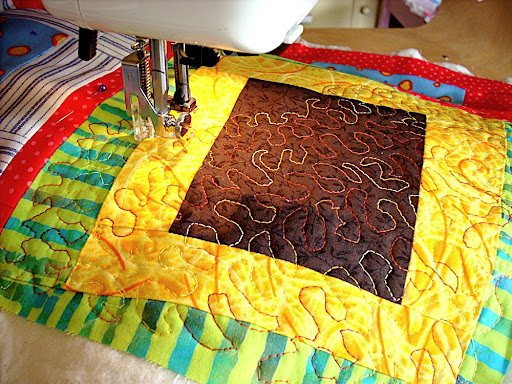
Now there are quilts, and there is quilting. The above is a Quilt. Quilting, though, is the little stitches that you put through all three layers. These stitches are both decorative and functional. They hold the quilt layers together, but you also use them to enhance, to outline, and to decorate.
For example. You might have a quilt made up of patchwork squares, all different patterns. When it comes to quilting, you might decide to quilt around the squares (this is called 'in the ditch', and means you sew in the seams that are already there).
You may decide to go diagonally across the squares, creating another layer of pattern. Or, you might decide to create an entirely new pattern on top of your squares by stitching stars, hearts, flowers, and so on.
Or, you could decide to sew a random pattern of squiggles, or stippling, using free motion quilting.
You might also use quilting to outline an existing pattern, if, hypothetically (Julie), you bought a printed panel with fairies, hungry caterpillars, or monkeys. You could then sew around certain lines to emphasise them.
A Definition
Quilting
![]() |
| 'In the ditch' quilting |
| Patchwork squares, outlined, seen from the back |
You may decide to go diagonally across the squares, creating another layer of pattern. Or, you might decide to create an entirely new pattern on top of your squares by stitching stars, hearts, flowers, and so on.
Or, you could decide to sew a random pattern of squiggles, or stippling, using free motion quilting.
| Stippling |
You can quilt by hand, or machine. Just make sure you buy the appropriate thread.
Quilting supplies
The following will be useful for your quilting life. There is a whole, large market devoted to quilting. In Edinburgh, I recommend Mandors. Online, try The Cotton Patch, or eBay.
- a rotary mat, and cutter
- a quilting ruler (go for a longish one, rather than a square)
- quilting safety pins, to baste, or hold your layers together, while you quilt
- quilting needles, either for your sewing machine or for hand quilting
- an iron
- 100% cotton thread
Rules for Making a Quilt
When it comes to making a quilt, really anything goes - but there are a few rules that will make your life easier.
- Always use 100% cotton thread. Over time (and we are talking a long time, but if you're making a quilt you are making an heirloom piece), other threads can wear through the fabric. Cotton shouldn't. Use thread for hand or for machine as appropriate (hand quilting thread is usually coated to make it easier to work with).
- The standard seam allowance is 1/4 inch.
- Pre-wash and shrink your fabric.
- Stretchy fabric generally isn't used for quilts. It can be, but requires extra prep - namely, making it not stretchy. Use an iron-on stabiliser to do this.
- Use a good quality wadding. You want it to be thin! The first time I tried to quilt, I bought wadding that looked like a marshmallow. It would have been good for making a puffy jacket, or a gillet, but not for a blanket. Think like a layer of felt - that's about what you're going for.
This is just a very basic explanation to get you started, Jules (and anyone else, who stumbled over here from the Octonauts pages). There are many, many more pages on the web that can help you with specifics, like what kind of quilt top to make, and what quilting method to use. But I hope this can help you on the way to becoming a quilting addict!
Monday, 4 July 2011
Quilt in an Hour (yes, really)
Now to be honest, this post should really be called 'quilt' in an hour. Technically, this is not a quilt. A real quilt is three layers: top, wadding, and backing. It's usually nicely edged with binding and finished by hand. It also takes substantially longer than an hour. However, if that's the kind of project you're looking for, read no further.
But for those of you who've not quilted before and want a little taster, or who need a quick and easy blanket, read on. This really is a 'quilt' you can make in an hour.
You will need:
Step 1: Get Ready
Line up your fabric and your fleece and pin together. You probably won't need to do much pinning as cotton and fleece tend to grip each other quite nicely.
Step 2: Quilt
Now, using your sewing machine, sew along the lines in the fabric to create the illusion of patchwork squares. Be careful to get right on the line, if you can, for the most authentic looking results.
Step 3: Finish the edges
Pin your binding around the edges. Slowly sew it in place. This can be trickier than it sounds, as you want your top and bottom to line up pretty exactly. If I were doing this again, I have to say I would probably add the binding in the traditional way and finish it by hand. But that would take a bit longer than an hour so...
And, you're done! A very serviceable, cozy quilted fleece, made in no time at all. And if you like this, there are lots of things you can do from here. Try using the patchwork fabric as a border around larger patchwork squares. Applique a name or a picture onto the fabric before you attach it to the fleece. Sew along the lines of the patchwork before attaching it to the fleece, and then try a more elaborate quilting pattern through the two layers. (Almost) instant (almost) quilts - definitely a winner.
But for those of you who've not quilted before and want a little taster, or who need a quick and easy blanket, read on. This really is a 'quilt' you can make in an hour.
You will need:
- fleece (I used 75 cm x 100 cm)
- patchwork fabric of the same size. I got this, but you can find more on eBay or in your local fabric shop
- thread
- bias binding. I bought pink cotton on eBay but you can use satin if you want. You don't want blanket binding, though, unless you want to finish it by hand.
- sewing machine
Step 1: Get Ready
Line up your fabric and your fleece and pin together. You probably won't need to do much pinning as cotton and fleece tend to grip each other quite nicely.
Step 2: Quilt
Now, using your sewing machine, sew along the lines in the fabric to create the illusion of patchwork squares. Be careful to get right on the line, if you can, for the most authentic looking results.
Step 3: Finish the edges
Pin your binding around the edges. Slowly sew it in place. This can be trickier than it sounds, as you want your top and bottom to line up pretty exactly. If I were doing this again, I have to say I would probably add the binding in the traditional way and finish it by hand. But that would take a bit longer than an hour so...
And, you're done! A very serviceable, cozy quilted fleece, made in no time at all. And if you like this, there are lots of things you can do from here. Try using the patchwork fabric as a border around larger patchwork squares. Applique a name or a picture onto the fabric before you attach it to the fleece. Sew along the lines of the patchwork before attaching it to the fleece, and then try a more elaborate quilting pattern through the two layers. (Almost) instant (almost) quilts - definitely a winner.
Wednesday, 1 June 2011
What I've Been Up To
You may have noticed a silence on the blog front. That's because I've been working on a project that is completely NOT in the ethos of Sew Bored. This project took me a full week to finish! And so, I am not blogging about it in a tutorial way, but just in a 'here's what I've been up to' way.
I was recently pointed to this amazing blog, and have been in absolute awe ever since. Her stuff is SO beautiful, and so lovely, and she makes it look easy! So when I found this tutorial, I had to give it a try.
I've been wanting to make a blanket for Rosa's bed, and I had a lovely piece of white flannel going spare, and so the project went from pillow to quilt. Essential to Don't Look Now!'s style is free motion quilting, which I've never tried, but I went and bought a free motion foot for my sewing machine and thought I'd give it a bash.
Basically...it didn't go too well. While Don't Look Now! lady uses free-motion stitching along the edge of her appliques...I couldn't. I ended up just doing my usual zig-zag stitch, which worked well enough. The real problem came with the actual quilting. Although by this point I had got a bit more practice (and am actually halfway through free-motion quilting another Top Secret UnBloggable project), I couldn't face trying it on this one too. So I quilted a sun, and some clouds, and some stars and squiggles and so on just to hold everything in place.
I LOVE the quilt top, but I am not a fan of my quilting. Still, for a practice project I'm fairly pleased, and I've got some ideas to use for next time. And if anyone knows of any classes in free motion quilting...Please let me know!
I was recently pointed to this amazing blog, and have been in absolute awe ever since. Her stuff is SO beautiful, and so lovely, and she makes it look easy! So when I found this tutorial, I had to give it a try.
I've been wanting to make a blanket for Rosa's bed, and I had a lovely piece of white flannel going spare, and so the project went from pillow to quilt. Essential to Don't Look Now!'s style is free motion quilting, which I've never tried, but I went and bought a free motion foot for my sewing machine and thought I'd give it a bash.
Binding, part 2
A lot of people (okay, three) have asked me about binding so we're returning to that topic for another look, specifically at how to bind a quilt.
Now I've said before and I'll say it again, I'm no expert. But I have now bound 5 quilts, using 3 different methods, and have gone from fearing and loathing the process to actually really enjoying it. What changed me? Well, after quilt 2 1/2, I got fed up and read the instructions. I never do this. But fed up with my messy, time consuming approach, I looked at the chapter on binding in my quilting book and voila, it made sense!
Here's how it works. (For the purpose of illustration, I'm using garish, non-matching colours. Don't worry. This project was straight for the bin and not an indication of my new creative direction!)
Step 1: attach your binding
See the previous tutorial for instructions on how to make binding. Assuming you've already got yours, line up the rough edges with the edge of your quilt. You're doing this on the top side of your quilt, so that top part will be machine sewn, and the back finished by hand.
With the edges lined up (pin if desired), sew the binding to the quilt. Don't start at a corner, and stop before you get to the corners - that's the next step!
Step 2: Corners
When you get about 1 inch away from the corner, stop stitching and take your needle out. Fold the binding up and off your quilt, to make a triangle as shown in photo A. Then, fold the binding straight back down, along the edge of the next side of your quilt (photo B). Put your needle into the top corner and continue sewing from there (photo C), until you reach your next corner - and repeat!
When you fold the binding over, it should look like this.
Step 3: Finishing by hand
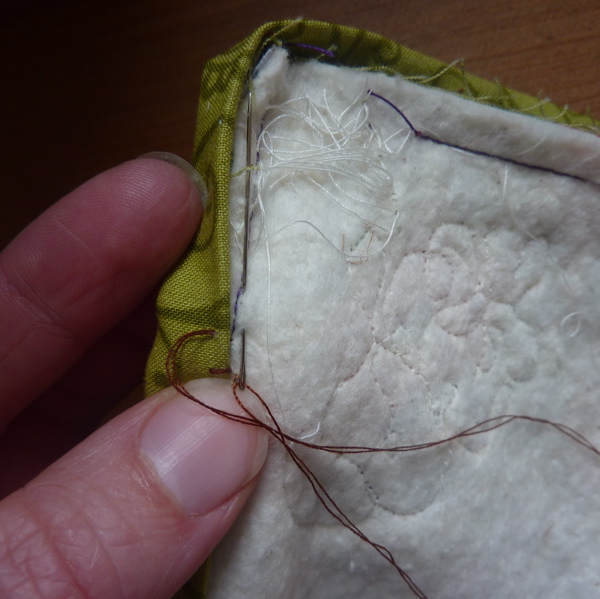
You're going to use what's apparently called an applique stitch. It's probably easier to let the photos do the talking, but basically you start by poking the needle up through the binding, and then into the back of the quilt. Move the needle along a bit under the back, then pop it up and through the binding again. Re-insert your needle into the hole you made coming up, and move it along again. And repeat.
That makes almost no sense when I read it back, but basically if you were to bisect train tracks and keep just one half, that's what you want to sew.
Have a look at the photos. That might make it clearer.
Your finished binding should look like this from the good side!
No idea if that helped or made things worse, but any questions please ask. Good luck!
Now I've said before and I'll say it again, I'm no expert. But I have now bound 5 quilts, using 3 different methods, and have gone from fearing and loathing the process to actually really enjoying it. What changed me? Well, after quilt 2 1/2, I got fed up and read the instructions. I never do this. But fed up with my messy, time consuming approach, I looked at the chapter on binding in my quilting book and voila, it made sense!
Here's how it works. (For the purpose of illustration, I'm using garish, non-matching colours. Don't worry. This project was straight for the bin and not an indication of my new creative direction!)
Step 1: attach your binding
See the previous tutorial for instructions on how to make binding. Assuming you've already got yours, line up the rough edges with the edge of your quilt. You're doing this on the top side of your quilt, so that top part will be machine sewn, and the back finished by hand.
With the edges lined up (pin if desired), sew the binding to the quilt. Don't start at a corner, and stop before you get to the corners - that's the next step!
![]() |
| Binding partially attached |
When you get about 1 inch away from the corner, stop stitching and take your needle out. Fold the binding up and off your quilt, to make a triangle as shown in photo A. Then, fold the binding straight back down, along the edge of the next side of your quilt (photo B). Put your needle into the top corner and continue sewing from there (photo C), until you reach your next corner - and repeat!
![]() |
| A |
![]() |
| B |
![]() |
| C |
Step 3: Finishing by hand
You're going to use what's apparently called an applique stitch. It's probably easier to let the photos do the talking, but basically you start by poking the needle up through the binding, and then into the back of the quilt. Move the needle along a bit under the back, then pop it up and through the binding again. Re-insert your needle into the hole you made coming up, and move it along again. And repeat.
That makes almost no sense when I read it back, but basically if you were to bisect train tracks and keep just one half, that's what you want to sew.
Have a look at the photos. That might make it clearer.
![]() |
| Step 1: poke your needle through the binding |
![]() |
| Step 2: move your needle back through the backing of your quilt, and along parallel to the edge of your binding. |
![]() |
| Step 3: bring your needle back up to the surface |
![]() |
| Step 3 again |
![]() |
| Step 4: loop back up through the binding, and down through the same hole you came up, to make a backwards L shape |
![]() |
| Step 5: continue along your quilt, taking tiny stitches into the edge of the binding |
Your finished binding should look like this from the good side!
No idea if that helped or made things worse, but any questions please ask. Good luck!
Wednesday, 4 May 2011
Baby Clothes Quilt - part 1 (The Quilt Top)
Last night, I finished something that's been in my bag for two years.
The project was a quilt made from my son's baby clothes. I came up with the idea when he was about 18 months old, and arbitrarily decided that it would include clothing up to when he turned 2. So, I had to wait for him to outgrow things - and he took his sweet time doing that. Then I lent some of his things to a friend who'd had a wee boy, and had to wait for him to outgrow them. And then, perhaps the most time-consuming part, I had to decide what I was going to do with them. Once all this was decided, the actual quilt took no time at all - but the getting there was a looooong process.
I am a hoarder when it comes to memories. I don't want to throw anything away. So the prospect of saying goodbye to these little stained shirts, worn out trousers, tiny pockets and buttons wasn't something I was capable of doing. Likewise, though, I couldn't keep them all. By the time I devised the project I already had four shopping bags of clothes that he had outgrown, and only one small cupboard to keep them in. So, I steeled myself and one afternoon I took the scissors, the rotary cutter, and a ruthless determination and started cutting.
This was definitely the hardest part, and there were a few things I couldn't bear to chop. The very first sleeper he wore is still intact, and a few other tiny vests and knitted things. But the stack of squares took up one (Clarks size 4 creepers) small shoe box instead of half a closet, and once I started there was no going back.
One of the biggest obstacles I faced was the fact that almost all of his precious clothes were made from stretchy, t-shirt material. Serious quilters will tell you that you CANNOT quilt with this. Less serious quilters will sacrifice perfection and do it anyway. More about how to do this below.
Before we get to the step by step, a few tips learned along the way:
1. Cut your squares a good few inches larger than you actually want them to be.
2. Try and get pockets, buttons, details, and prints in - but avoid having anything bulky (snaps, thick seams) at the edge of your squares.
3. It doesn't have to be a complete archive. If there's something you can't bear to cut, don't.
My finished quilt used 63 squares, each 5 inches when finished. You can adapt as needed!
You will need:
-a rotary cutter and mat (not absolutely essential, but they will make your life easier)
-a quilting ruler
-iron-on stabiliser. I have no idea what brand I got, and there are a lot of varieties, but you want something very lightweight that will make stretchy stuff not stretchy. Ask your friendly fabric shop, or search on The Cotton Patch website for stabilisers (like these). You can even get super fancy ones that wash away when you first launder your quilt, meaning that the slight stiffness you get from a stabiliser vanishes. I didn't go for this option, simply because of the cost, but feel free!
-100% cotton thread, suitable for machine quilting (NOT hand quilting)
-a stack of baby clothes to make 63 fabric squares
-fabric for the sashing (on mine, that's the white cotton that frames each square)
-an iron
-a sewing machine
A note on fabrics. I like cotton, and I particularly like brushed cotton. Flannel is also lovely. You don't want anything too heavy and bulky, but otherwise there are no real rules. It helps if you like it and like sewing with it!
Step 1: making your squares
Assemble your baby clothes and your nerves and start cutting. At this point, cut out the squares larger than you actually want them to be: you won't trim them down to their proper size until they've been stabilised. For my quilt, I cut out 6 inch squares.
Once you have a stack of squares, you need to iron-on the stabiliser. Do this according to the instructions on the brand you've bought. Now you're ready to trim them down and make them into nice, neat squares of the size you want.
The finished size of the squares in my quilt is 5 inches, in order to incorporate some of the larger designs in the fabric. Whatever size square you want, make sure you add half an inch to allow for seams. So, for my 5 inch squares I cut out 5 1/2 inch squares.
Step 2: making your sashing
Sashing is the white stripes that surround each of the patchwork squares in my quilt. I wanted a finished border of 1 1/2 inches, so again allowing for seams I cut strips that were 2 inches wide. You want 6 long strips (to go between the columns), 56 5 1/2 inch strips, and enough white for a border all around your quilt.
Step 3: lay out the quilt
Get a big piece of floor and lay out your pieces how you want them to go. My quilt is 7 squares across x 9 squares down. Arrange to your hearts desire.
Step 4: start sewing
*** ALWAYS use a 1/4 inch seam allowance ***
Sew your squares together in columns, adding a piece of 5 1/2 sashing between each square. You should end up with a long, narrow panel of 9 squares, divided by bits of white. You want seven of these. Turn them over and press the seams open flat.
Once you have your 7 columns, you need to add a long strip of white between them and sew them all together. Then, when you have a big rectangle, add your white border. First, cut two white pieces to go across the top and bottom of your quilt, and then once they are sewn on add the borders down the sides.
Remember to press all the seams out so your quilt top is nice and neat.
Ta da! Your quilt top is finished. In the next instalment, we'll finish it off!
The project was a quilt made from my son's baby clothes. I came up with the idea when he was about 18 months old, and arbitrarily decided that it would include clothing up to when he turned 2. So, I had to wait for him to outgrow things - and he took his sweet time doing that. Then I lent some of his things to a friend who'd had a wee boy, and had to wait for him to outgrow them. And then, perhaps the most time-consuming part, I had to decide what I was going to do with them. Once all this was decided, the actual quilt took no time at all - but the getting there was a looooong process.
I am a hoarder when it comes to memories. I don't want to throw anything away. So the prospect of saying goodbye to these little stained shirts, worn out trousers, tiny pockets and buttons wasn't something I was capable of doing. Likewise, though, I couldn't keep them all. By the time I devised the project I already had four shopping bags of clothes that he had outgrown, and only one small cupboard to keep them in. So, I steeled myself and one afternoon I took the scissors, the rotary cutter, and a ruthless determination and started cutting.
This was definitely the hardest part, and there were a few things I couldn't bear to chop. The very first sleeper he wore is still intact, and a few other tiny vests and knitted things. But the stack of squares took up one (Clarks size 4 creepers) small shoe box instead of half a closet, and once I started there was no going back.
One of the biggest obstacles I faced was the fact that almost all of his precious clothes were made from stretchy, t-shirt material. Serious quilters will tell you that you CANNOT quilt with this. Less serious quilters will sacrifice perfection and do it anyway. More about how to do this below.
Now the two years of planning, saving and cutting means this isn't really a project that can be made in a nap. However, it can easily be broken up into nappable-sized chunks, which is largely how I got it done. Depending on how quickly you work, this is probably a week's worth of naps - maybe a bit more if your handsewing is a bit rusty.
Before we get to the step by step, a few tips learned along the way:
1. Cut your squares a good few inches larger than you actually want them to be.
2. Try and get pockets, buttons, details, and prints in - but avoid having anything bulky (snaps, thick seams) at the edge of your squares.
3. It doesn't have to be a complete archive. If there's something you can't bear to cut, don't.
My finished quilt used 63 squares, each 5 inches when finished. You can adapt as needed!
You will need:
-a rotary cutter and mat (not absolutely essential, but they will make your life easier)
-a quilting ruler
-iron-on stabiliser. I have no idea what brand I got, and there are a lot of varieties, but you want something very lightweight that will make stretchy stuff not stretchy. Ask your friendly fabric shop, or search on The Cotton Patch website for stabilisers (like these). You can even get super fancy ones that wash away when you first launder your quilt, meaning that the slight stiffness you get from a stabiliser vanishes. I didn't go for this option, simply because of the cost, but feel free!
-100% cotton thread, suitable for machine quilting (NOT hand quilting)
-a stack of baby clothes to make 63 fabric squares
-fabric for the sashing (on mine, that's the white cotton that frames each square)
-an iron
-a sewing machine
A note on fabrics. I like cotton, and I particularly like brushed cotton. Flannel is also lovely. You don't want anything too heavy and bulky, but otherwise there are no real rules. It helps if you like it and like sewing with it!
Step 1: making your squares
Assemble your baby clothes and your nerves and start cutting. At this point, cut out the squares larger than you actually want them to be: you won't trim them down to their proper size until they've been stabilised. For my quilt, I cut out 6 inch squares.
Once you have a stack of squares, you need to iron-on the stabiliser. Do this according to the instructions on the brand you've bought. Now you're ready to trim them down and make them into nice, neat squares of the size you want.
The finished size of the squares in my quilt is 5 inches, in order to incorporate some of the larger designs in the fabric. Whatever size square you want, make sure you add half an inch to allow for seams. So, for my 5 inch squares I cut out 5 1/2 inch squares.
Step 2: making your sashing
Sashing is the white stripes that surround each of the patchwork squares in my quilt. I wanted a finished border of 1 1/2 inches, so again allowing for seams I cut strips that were 2 inches wide. You want 6 long strips (to go between the columns), 56 5 1/2 inch strips, and enough white for a border all around your quilt.
Step 3: lay out the quilt
Get a big piece of floor and lay out your pieces how you want them to go. My quilt is 7 squares across x 9 squares down. Arrange to your hearts desire.
Step 4: start sewing
*** ALWAYS use a 1/4 inch seam allowance ***
Sew your squares together in columns, adding a piece of 5 1/2 sashing between each square. You should end up with a long, narrow panel of 9 squares, divided by bits of white. You want seven of these. Turn them over and press the seams open flat.
Once you have your 7 columns, you need to add a long strip of white between them and sew them all together. Then, when you have a big rectangle, add your white border. First, cut two white pieces to go across the top and bottom of your quilt, and then once they are sewn on add the borders down the sides.
Remember to press all the seams out so your quilt top is nice and neat.
Ta da! Your quilt top is finished. In the next instalment, we'll finish it off!
Subscribe to:
Comments (Atom)