Showing posts with label abcs of sewing. Show all posts

Thursday, 2 August 2012

"Bye, baby bunting..."

It's been a while, for which I apologise. I have two excuses. First, I've mostly been making the same thing. I'm in a bunting stage. First it was some Special Leaving Bunting (see below). Then it was name bunting for a friend's new baby and new baby's big sister, and then it was my favourite bunting of all (again, see below). So, not much to report. I've already shared my bunting making instructions, and these are really variations on a theme.

The second excuse is better. My sewing machine broke. It started to skip the odd stitch in the middle of making Special Leaving Bunting, and when I went to make the name bunting it became totally unusable. Into the shop it went, for what was meant to be 3 days and ended up being nearly two weeks. I missed it. A lot.

However, it is back and I finally managed to finish off a few projects, clear the desk a bit, and realise I need something new. And so, I found this site which offers PDF patterns WITH TUTORIALS at quite bargainous prices. This is big for me, because up to now my inability to follow pattern instructions has meant that most the things I make are designed through trial and error. I've just bought the very cute hoodie pattern, and I'm hoping to whip a few up this weekend. I'll let you know how it goes.

But back to the bunting. This Special Leaving Bunting was a collaborative effort, made for a friend who at short notice told us she was moving to the other end of Britain. No time to make a quilt or something more elaborate, but there was time enough to rally the troops to make a triangle of fabric which was then strung together to make bunting. Of course, they all outdid themselves. I'd been expecting plain bits of cotton but they crocheted, appliqued, painted, embroidered, and adorned with style. In the end, we had a massive string of bunting with lovely messages written on the backs of the flags, and I think she did like it. If you are after a group project, this is a good one - how nice would it be for a wedding/christening/birthday/anything?


That finished, it was time to tackle my Favourite Bunting of All Time, aka Alphabet Bunting. It is, really, as it sounds. It involved a lot of applique and some dictionary searching (J and N were very tricky!) but in the end, I'm really pleased with it.


If you want to make something similar, here are my tips and lessons learned.

1. I made rectangles rather than triangles just so I could fit everything in. If you wanted triangles, I'm sure it could be done if you used just upper or lower case letters.

2. I bought the cheapest white cotton I could find - 2 metres of it - for making the flags. It ended up being curtain lining and £4/metre for 100% cotton - not bad. However, if I made this again I would buy a slightly higher quality. This stuff ravelled like mad.

3. I used black felt for the letters. Felt is very forgiving when you applique, and it meant if my stitches weren't exactly on the edge it didn't show up, and if I missed a bit I didn't have to worry about it fraying.

4. Use an assembly line approach to the applique. Do all the pinks/reds/yellows/blues at once so that you don't have to thread and rethread your machine more than needed.

5. Cheat. In the end, I used fabric pens for a lot of small details. It saved me from going completely crazy.


6. Think about your images. As well as being easy to applique, it helps to have things that are relevant to your kids. I struggled most with the letter N, thinking nappies, nose, and finally Nessie which I thought would be great - but then the kids might see it as a snake, monster, serpent... We were just back from New York so in the end that won. I also wanted things that made the sound of the letter, so as much as I wanted Owl for O, Octopus won.


Once the bunting started to come together, I realised it really would have made a fabulous quilt. Only the low quality cotton and felt letters kept it from becoming a blanket, but I may well make this again as a present. For someone I really, really like. It was a really fun project, though - one I was almost sorry to finish.


Friday, 12 August 2011

ABCs of Sewing: Q is for Quilting

I've decided to go out of order here. If you'd been paying attention, you might think that the next letter coming was D (which will be for darning, if I ever get to it). But this morning, a friend in need berated me for not actually explaining what a quilt entailed. All apologies. And just for you, Julie (since every other reader of this blog seems to be here just for the Octonauts things - not joking. Well over half of my all time readers...), here are the ABCs of quilting.

A Definition

First: what is a quilt? Well, it's a sandwich of fabrics consisting of a top layer (quilt top), middle layer (wadding, or sometimes batting), and bottom layer (backing). It's usually finished with binding. The whole things makes a blanket which is viewable from both sides, so unlike most things you sew there is no 'wrong' side in the finished project.

Quilting

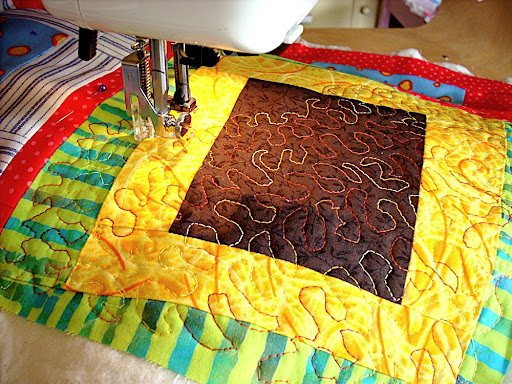
Now there are quilts, and there is quilting. The above is a Quilt. Quilting, though, is the little stitches that you put through all three layers. These stitches are both decorative and functional. They hold the quilt layers together, but you also use them to enhance, to outline, and to decorate.

'In the ditch' quilting
Patchwork squares, outlined, seen from the back
For example. You might have a quilt made up of patchwork squares, all different patterns. When it comes to quilting, you might decide to quilt around the squares (this is called 'in the ditch', and means you sew in the seams that are already there).

You may decide to go diagonally across the squares, creating another layer of pattern. Or, you might decide to create an entirely new pattern on top of your squares by stitching stars, hearts, flowers, and so on.

Or, you could decide to sew a random pattern of squiggles, or stippling, using free motion quilting.
Stippling
You might also use quilting to outline an existing pattern, if, hypothetically (Julie), you bought a printed panel with fairies, hungry caterpillars, or monkeys. You could then sew around certain lines to emphasise them.

You can quilt by hand, or machine. Just make sure you buy the appropriate thread.

Quilting supplies

The following will be useful for your quilting life. There is a whole, large market devoted to quilting. In Edinburgh, I recommend Mandors. Online, try The Cotton Patch, or eBay
  • a rotary mat, and cutter 
  • a quilting ruler (go for a longish one, rather than a square) 
  • quilting safety pins, to baste, or hold your layers together, while you quilt 
  • quilting needles, either for your sewing machine or for hand quilting 
  • an iron 
  • 100% cotton thread
Rules for Making a Quilt

When it comes to making a quilt, really anything goes - but there are a few rules that will make your life easier. 
  1. Always use 100% cotton thread. Over time (and we are talking a long time, but if you're making a quilt you are making an heirloom piece), other threads can wear through the fabric. Cotton shouldn't. Use thread for hand or for machine as appropriate (hand quilting thread is usually coated to make it easier to work with).
  2. The standard seam allowance is 1/4 inch.
  3. Pre-wash and shrink your fabric.
  4. Stretchy fabric generally isn't used for quilts. It can be, but requires extra prep - namely, making it not stretchy. Use an iron-on stabiliser to do this.
  5. Use a good quality wadding. You want it to be thin! The first time I tried to quilt, I bought wadding that looked like a marshmallow. It would have been good for making a puffy jacket, or a gillet, but not for a blanket. Think like a layer of felt - that's about what you're going for.
This is just a very basic explanation to get you started, Jules (and anyone else, who stumbled over here from the Octonauts pages). There are many, many more pages on the web that can help you with specifics, like what kind of quilt top to make, and what quilting method to use. But I hope this can help you on the way to becoming a quilting addict!

Monday, 20 June 2011

ABCs of Sewing: C is for Cutting out

Cutting out is probably my least favourite bit of sewing. It's not because of the absolute terror I feel every time I cut into a crisp, pristine length of fabric. No, my hatred lies elsewhere.

As my mother says, sewing is 90% cutting out and pinning, and only 10% actual sewing. The sewing bit, I like. The other bits, I endure. The reason for my loathing? It probably has to do with the fact that cutting out requires precision and care. To get the best results, you want to be consistent and careful, making little marks to help line up the pieces and ensuring the pattern doesn't move. I am not good at this.

It is worth being good at this, though, as dressmaking and pattern-following kind of relies on it. Too often when I work from a pattern I have to fudge or fidget pieces to make them match up, whereas if I'd just taken more care when cutting I'd have had a much simpler job.

I dream of a laser cutter, or barring that a small nimble-fingered assistant who delivers stacks of neatly cut, folded and labelled pattern pieces, complete with their delicate parchment pattern piece pinned on top. Until then, here's what I've learned about cutting out. As with many things in my sewing room, do as I say, not as I do.

1. To pin, or not to pin? Apparently, the more pins the better. My mother pins like mad. But I find the more I pin, the more I shift the pattern pieces and mess myself up. I create puckers and folds and tears where there needn't be. (And you can read that 'tears' both as rends in the garment, and weeping. They both happen.) My preferred method, where possible, is to simply weight the pattern down. An old seamstress friend would use heavy, smooth rocks instead of pins - something I will definitely do in my (imaginary) sewing room!

2. Choose your surface wisely. Again, I preach from experience. I have cut through rugs, papers, and layers of fabric that I didn't mean to cut through. The best surface is a big table, if you have one. I don't, so I use the floor. But I should really remove the children's toys before I use the floor. And maybe sweep up, too. Nice as it is to pick up your fabric covered in toast and apple juice...

3. Different projects call for different methods. (And levels of care, for the matter.) For some things, you can get away with an extra inch here or there. Others, you can't. For example, I made a child's sun hat a few weeks back. Only I ignored the precision required in the measurements and now the child's sun hat fits me, and not my 18 month old. Oops. But as far as methods go:
  • Applique: When it comes to appliques, you have to be quite careful with your cutting. I find the easiest way to get a neat shape is as follows. Trace your shape directly onto your Bond-a-web (make sure you flip it over if it has a right and a wrong way, like letters!). Cut loosely around the shape and then iron it onto the fabric. Once it is fused on, cut it out along the lines you traced for a neat, sharp shape.
  • For quilting, a rotary cutter and board are your friends. You will need a good ruler as well, and the cost does add up. Look on the internet for the best deals. I use an Olfa 45mm rotary cutter, a small omni mat (although if I could do it again, I'd probably buy a bigger one), and a 6x18 inch ruler. Once you've got your rotary cutter, though, you'll never look back. You can cut through several layers of fabric at once, quickly, and with great precision. Great for cutting squares, strips, and triangles for bunting!
4. Choose your tools well. You will absolutely need a good pair of scissors. Don't use them for anything but sewing. Buy good pins (with appealing colours on top!) and a pin cushion to keep them in. My mum had a great one that she could wear on her wrist - I've not found one but I'm on the hunt!

I'm not saying cutting out will ever be fun, but hopefully this will help. And if nothing else, it might serve as a cautionary tale (see photo).
    The sun hat, meant to be for a toddler. Oops.

Wednesday, 4 May 2011

ABCs of sewing: B is for Binding


Binding is another one of those things that used to scare me, so I avoided it. However, a few months ago I made a quilt and unlike my other quilting attempts where I cheated and did the binding on a sewing machine (more on this later), this one I wanted to do properly. A quilting friend showed me what to do and surprise, it actually wasn't that scary at all. And now I use it ALL the time. Like this skirt. I wanted to add a touch of colour, so instead of hemming it I put binding top and bottom. Et voila!


I use binding on the edges of necks and sleeves, along the top of a cloth bag, around the edge of a cushion, and of course on a quilt.  There are different ways to do it, but here is mine.

You will need:
- strip of fabric, 2 inches wide and as long as you need it. If you can't get the required length in one continuous piece, don't worry. Just cut as many pieces as you need to get there. (To make your life easier, you may well want to use a rotary cutter and mat, or at least a good ruler and a fabric pen - the kind that fades within 24 hours - to mark your lines. You do want to be quite precise here.)
- sewing machine and iron


Step 1: joining pieces

If you don't have one single piece of fabric that is long enough for your purposes, you will need to join pieces together. You do this by placing two pieces of fabric right side down so that their corners form a right angle. 

You then sew across this angle from the bottom left point to the top right point


Open the strip out and you should have joined the two pieces with what looks like a diagonal seam.


 Trim the back, and press it flat. Join as many pieces as you need, but make sure that all the seams are on the same side. (I say this from experience: when I was making this piece, I had to tear out four sections which I'd sewed together back to front. Oops.)


Step 2: Ironing

Now that you've got your very long length, you need to fold it in half length-wise and press it. You should now have a very long, 1 inch tall strip.


Step 3: Attaching the binding

Now these pictures show the binding going onto a quilt, but the premise is the same no matter what you're attaching it to. You want to lay the binding on top of the good side of your quilt/garment/whatever so that the rough edges line up. You're then going to sew the binding on, following along the edge, as shown:


Step 4: Finishing


Now fold the binding around so that it covers all the rough edges and ends up on the back of your quilt/garment/whatever. If you're making a quilt, you'll probably want to take time and finish the other edge by hand using as neat and hidden stitches as possible (see below).

However, if this is just for a skirt or something that isn't going to be closely inspected from both sides, I'm all for just whipping it on with a machine. Unless you're very careful, the stitches will probably show a bit but I don't mind. If you're doing it by machine, fold the binding under and then sew through all the layers, from the top, positioning your needle in the groove where you joined the binding on. The stitches will show on the other side, but shouldn't be too visible from the top. You can see the finished effect on that skirt - the wrong side clearly shows the pink stitching, but the right side looks pretty good!


There you go. A rough guide to binding. Sometime I will show you the very easy, very cheating way to bind a quilt by machine - but that's enough about binding for now.

Friday, 29 April 2011

ABCs of Sewing: A is for Applique

Applique is a wonderful, wonderful thing. For a year I resisted it because I thought it sounded complicated and scary when in truth, it is easy as pie and can look great. There are lots of different ways you can applique, but for me, this method is the best.


(This is my first attempt at applique, done on a baby's quilt)

You will need: 

- Fabric scraps
Bondaweb, or a similar product, which acts can be ironed on and glues the two pieces of fabric together
- A sewing machine with a zig-zag stitch
- A pattern, which can be drawn, cut out, or printed off sites like Free Applique (ignore the cheesy look - of the site - there's a lot on there!)
- Scissors
- An iron

Now cast your mind back to your early school years. This is basically just cutting out and glueing. Cut out the shapes you want from the fabric you want. Cut matching pieces of Bondaweb. Piece and layer them together as desired and arrange where you want them to go. Now, just iron them down (follow the instructions on your bondaweb or bondaweb substitute!).

You can finish here, but to make it look good and last, you now want to sew around the edges of your applique. Set your sewing machine to a zig-zag stitch and make your stitches quite small and tight, as though you were sewing a button hole. Stitch around the applique: individual pieces, the whole thing, whatever you like.


And now, you really are finished! It takes no time at all and looks brilliant. Try adding a name to a child's shirt, an embellishment to a plain coloured t-shirt, or a flower to a cotton shopping bag. The possibilities are endless, and the more you sew the larger your bag of applique-worthy scraps!